Supporting women and vulnerable communities to recover from flooding, protect their livelihoods and prepare for future climate-related disasters
Flooding is a recurring reality for many communities in Bayelsa State. Beyond damaging homes, farms and infrastructure, floods can disrupt livelihoods, restrict access to healthcare and clean water, and place additional pressure on women and girls who often carry significant responsibility for household income, food security and caregiving.
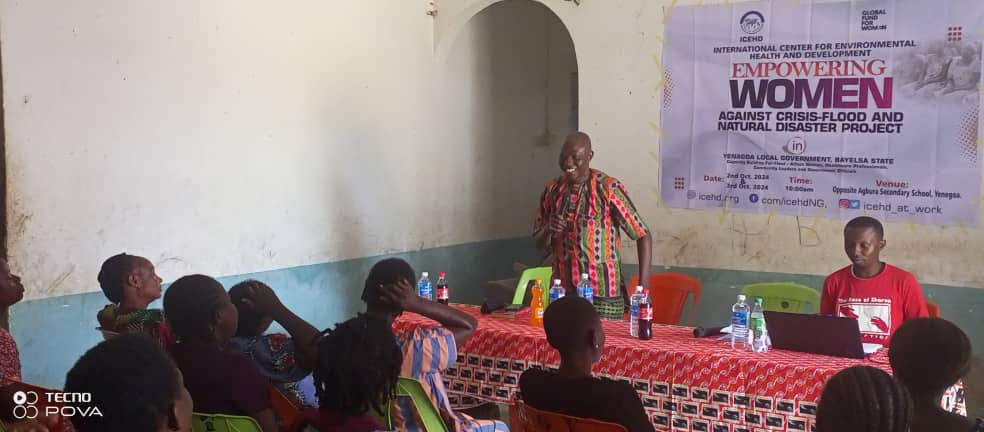
Recognising these interconnected challenges, the International Centre for Environmental Health and Development (ICEHD) implemented the Empowering Women Against Crisis – Flood and Natural Disaster Project in Yenagoa Local Government Area of Bayelsa State.
The intervention reached communities in Azikoro, Agbura and Amassoma, combining immediate support with longer-term measures designed to strengthen women’s resilience to future climate and disaster-related shocks.
A response built around women and community resilience
The project reached 1,122 individuals through a combination of disaster preparedness, emergency maternal healthcare, livelihood recovery, climate-smart agriculture, medical outreach, psychosocial support and clean water interventions.
Key results included:
Rather than treating these needs separately, the intervention recognised that recovery from disaster requires an integrated approach. A woman whose farm has been destroyed may also face reduced household income, increased caregiving responsibilities, difficulty accessing healthcare and greater exposure to unsafe water.
The response therefore focused on strengthening the conditions that enable women and communities to recover and become better prepared for the next crisis.
When flooding becomes a livelihood crisis
For women farmers in affected communities, flooding was not simply a temporary environmental disruption. It threatened the foundations of household income and food security.
Crops, farm inputs and productive assets were lost or damaged, including yam seedlings, cassava stems, plantain suckers and stored produce. Flooded roads also made it more difficult for farmers and traders to access markets and sustain their businesses.
To support recovery, ICEHD provided 37 women and families with agricultural and protective resources, including raincoats, rain boots, yam seedlings, cassava stems, plantain suckers, organic fertilisers and other farm-support resources.
The intervention went beyond replacing what had been lost.
Women farmers were also introduced to climate-smart agriculture, climate adaptation and mitigation practices, with attention to farming approaches and crops that can better respond to the realities of flood-prone environments.
This shift from recovery to resilience is important. Replacing lost inputs can help a family restart production, but building knowledge and adaptive capacity can help reduce vulnerability to future climate shocks.
Strengthening emergency maternal healthcare
Flooding can turn an ordinary journey to a health facility into a serious challenge.
When roads become impassable and transportation is disrupted, women in rural communities may depend heavily on Traditional Birth Attendants and other community-level health providers.
During the project, TBAs shared experiences of supporting pregnant women during difficult emergency situations, sometimes without adequate knowledge, equipment or access to timely referral services.
These experiences highlighted an important gap in community-level emergency preparedness.
ICEHD therefore conducted emergency maternal health training involving 30 TBAs, four medical practitioners and one Ministry of Health official.
The training focused on recognising the nine emergency signs in maternal care, responding appropriately and understanding when urgent referral is required.
The objective was clear: strengthen the capacity of frontline community health actors so that they are better prepared to respond when emergencies occur and access to formal healthcare becomes difficult.
The experience reinforced a critical lesson: emergency maternal health preparedness must happen before a disaster, not during one.
Addressing health risks after flooding
Flooding can increase exposure to unsafe water and create conditions that contribute to the spread of waterborne diseases and other health problems.
ICEHD provided free medical services to 85 women in affected communities.
The outreach included health consultations, malaria screening, maternal health support, blood pressure checks, eye examinations, treatment for common health conditions and health education.
Health education also emphasised hygiene and disease prevention, particularly in the aftermath of flooding when access to safe water and sanitation can become more challenging.
The intervention provided immediate healthcare while reinforcing community knowledge around prevention and early attention to health concerns.
Clean water for approximately 1,000 community members
Access to safe water emerged as one of the most pressing needs during the crisis.
In response, ICEHD supported the installation and commissioning of a borehole in Azikoro, improving access to clean water for approximately 1,000 community members.
The water intervention has broader implications for women and girls, who frequently bear a significant share of household water-collection responsibilities.
Improved access to a safer water source can reduce dependence on unsafe alternatives, lower exposure to waterborne diseases and reduce the time and physical burden associated with collecting water.
The intervention also highlighted an important challenge.
Finding a suitable site for the borehole was difficult because of the characteristics of the land. More importantly, the experience demonstrated that a single water point cannot adequately meet the needs of a wider community.
This has strengthened the case for additional water infrastructure in underserved areas of the community, alongside better assessment and planning before future installations.
Supporting emotional recovery
Disasters leave impacts that are not always visible.
Women and girls affected by flooding experienced loss, financial pressure, displacement, uncertainty and disruption to their daily lives. These experiences can affect emotional wellbeing and the ability of individuals and families to recover.
ICEHD provided psychological support and counselling to 60 women, girls and community members affected by the crisis.
The intervention supported participants in managing stress, emotional distress and the psychological effects associated with crisis and loss. Project monitoring reported a 50% reduction in reported stress and anxiety among participants.
This component reinforced an important principle of disaster response: recovery is not only about rebuilding physical assets and livelihoods. People also need space and support to recover emotionally.
A story of recovery: Mama Justina Andrew
For women such as Mama Justina Andrew, the impact of flooding reaches far beyond the loss of crops.
When farms and productive assets are damaged, the consequences can extend to household income, food security and the ability to meet everyday needs.
Through the women farmer empowerment component of the project, affected women received agricultural resources and practical support to restart their livelihoods.
The accompanying focus on climate-smart agriculture, adaptation and mitigation also provided knowledge that can support more resilient farming decisions in the future.
Mama Justina's experience reflects a broader lesson from the intervention:
When women have access to resources, knowledge and opportunities, they can move from recovering from crisis to building resilience against the next one.
What the crisis taught us
The response revealed that effective disaster preparedness cannot begin when floodwaters arrive.
It must begin with communities, systems and institutions preparing beforehand.
Several lessons emerged from the project:
Preparedness saves time and strengthens response
Flooding disrupted transportation, field activities and access to affected communities. Future interventions therefore require stronger contingency planning, emergency protocols, risk assessments and practical preparedness exercises before disasters occur.
Community health providers need continuous support
TBAs can become critical frontline actors when formal healthcare services are difficult to reach. Their commitment must be matched with appropriate training, resources and functioning referral systems.
Women farmers need more than replacement inputs
Replacing destroyed agricultural inputs is important, but long-term resilience requires access to climate-smart knowledge, appropriate crops, adaptive farming practices and continued livelihood support.
Infrastructure must be planned for real community needs
The Azikoro borehole demonstrated the immediate value of clean-water infrastructure while also revealing the need for additional water points and better assessment of future demand.
Logistics are part of emergency preparedness
Flooded roads and transportation challenges affected the movement of staff, health workers and community members. Emergency mobility and transportation planning must therefore be incorporated into project design from the outset.
Women and young people are not only beneficiaries
Women and youth demonstrated their capacity to contribute to community coordination, recovery and leadership.
Their knowledge and participation are essential to developing disaster responses that are locally relevant and sustainable.
From crisis response to resilience
The project has strengthened ICEHD's approach to disaster response.
The focus is increasingly moving from relief alone to preparedness, prevention, resilience and women-led solutions.
This means:
This approach reflects the reality that climate-related disasters are not isolated events. Communities facing recurring floods need solutions that help them prepare, adapt, recover and continue building their livelihoods.
Women at the centre of climate and disaster resilience
The experience in Bayelsa State reinforces the connection between women's rights, climate change, health, livelihoods and access to basic services.
For women in flood-prone communities, a flood can mean the loss of a farm, household income, access to healthcare, safe water and personal security—all at the same time.
Women should therefore not be viewed solely as recipients of humanitarian assistance.
They are farmers, caregivers, entrepreneurs, health actors, community leaders and decision-makers whose knowledge and leadership are critical to effective disaster preparedness and recovery.
Investing in women is consequently an investment in wider community resilience.
Looking ahead
ICEHD will continue to strengthen its work around women-led resilience and climate-related disaster preparedness.
Priority areas include expanding emergency maternal health training for TBAs, strengthening community health capacity, supporting climate-resilient agriculture, continuing livelihood interventions, improving access to clean water and strengthening partnerships that can mobilise resources for vulnerable communities.
The Bayelsa experience has shown that effective crisis response must look beyond the immediate emergency.
It must ask a bigger question:
What will enable women and communities to withstand the next crisis better than the last one?
For ICEHD, the answer lies in investing in knowledge, livelihoods, health, infrastructure, leadership and community-driven solutions.
When women have the resources, skills and opportunities to prepare for climate-related shocks, they do more than recover from disasters.
They help their families and communities become stronger, more resilient and better prepared for the future.