For over six years, Tolani has not lived entirely at ease.
She had brought forth her bundle of joy, but exiting the hospital did not mean exiting everything childbirth had taken from her.
The aftermath became part of her routine.
For 2,190 days, she carried two pairs of underwear wherever she went.
She avoided colors as bright as her daughter’s smile
Tolani is one woman, but her story reflects the experiences of millions of mothers.
The celebration ends. The photographs are taken. The congratulations fade.
But for some women, the aftermath becomes a lifestyle.
Tolanis Story Is not explaining her battles, it exposes a larger reality. Maternal health doesn’t disappear once she brings forth her bundle of joy.
The scale of maternal health challenges is already alarming. According to the World Health Organization, an estimated 287,000 women died from maternal causes in 2020. The major direct causes included severe bleeding, infections, hypertensive disorders, unsafe abortion and obstructed labor, while conditions such as anemia, malaria and heart disease can contribute indirectly.
But death is only part of the story.
What does survival look like for the women who make it out alive?
For some women, surviving childbirth isn't flowers and glitter. It is a challenge that can stretch across a lifetime. The delivery may be over, the baby may be in their arms, and the world may finally breathe a sigh of relief but for the mother, the health hurdles may not be over.
Sometimes, surviving one health hurdle simply means beginning another.
The consequences can live in the body. Some women experience persistent pain, pelvic-floor disorders, incontinence, fistula or other complications that can interfere with everyday life.
But not every wound can be seen.
A difficult childbirth experience can also leave consequences for a woman's mental wellbeing, including psychological distress, anxiety, depression or trauma What happened in the delivery room can continue to shape how she feels about her body, her motherhood and even the possibility of going through pregnancy again.
Then there is the question of what comes next.
For some women, pregnancy and childbirth can affect their reproductive and sexual health, their future pregnancies or their relationships. And when a health problem changes how a woman moves through her everyday life how she works, interacts with others, cares for herself or participates in her community it becomes more than a medical problem.
It becomes a social one.
This is why maternal health cannot be measured only by whether a woman survived childbirth. WHO itself stresses that simply surviving pregnancy and childbirth cannot be the sole marker of successful maternal healthcare; reducing maternal injury and disability and promoting women's health and wellbeing are also essential.
So why do we so often treat childbirth as the end of the Journey
The baby arrives. The mother is congratulated. The hospital doors close behind her.
But who asks what happens next?
Who asks whether she is still in pain months later? Whether she understands the changes happening to her body? Whether she has access to care? Whether she has recovered not just physically, but mentally, socially and emotionally?
For many women, the expectation can become simple: endure it. Its normal. Your not the first nor the last woman too experience such.
But suffering should not become a requirement of motherhood.
Ending maternal agony therefore requires more than helping women survive childbirth. It requires systems that continue to care for women after delivery, communities that take their concerns seriously, healthcare professionals who recognize and treat complications, policymakers who invest in accessible and quality maternal healthcare, and women who are empowered with the knowledge and support to seek care when something does not feel ri
Who is already changing the reality?
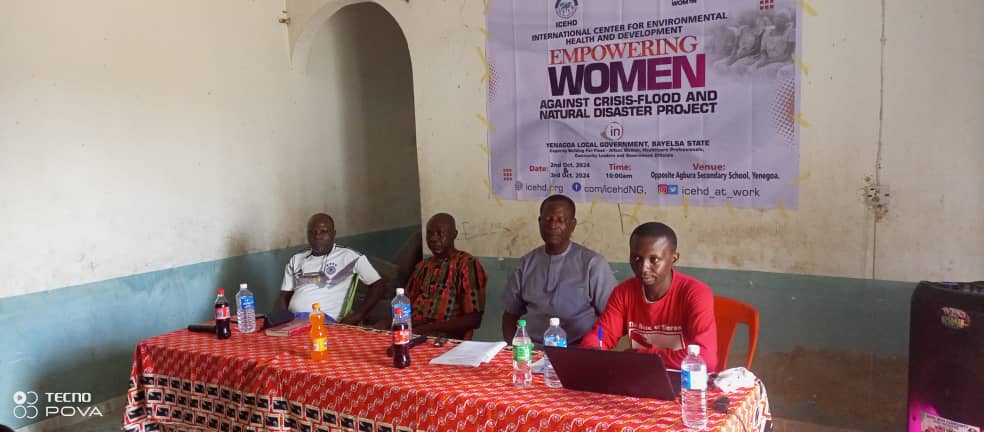
The International Centre for Environmental Health and Development (ICEHD) works on maternal, sexual and reproductive health, including through its Maternal Health, Sexual and Reproductive Rights Initiative. One part of its work focuses on strengthening the role of traditional birth attendants in communities where access to skilled healthcare can be difficult. ICEHD reports training more than 600 birth attendants across Ojo, Iba, Oto-Awori and Ado Odo-Ota, with training covering recognition of danger signs, referral procedures, safer delivery practices and record-keeping, alongside the provision of medical equipment and digital tools.
Work like this matters because preventing maternal harm is not only about what happens inside a hospital. It is also about what happens before a woman reaches one, whether danger signs are recognized, whether she can be referred quickly, and whether the people supporting her have the knowledge and resources to act.
But no organization can carry the responsibility alone.
Maternal health belongs to healthcare systems, governments, communities, families, organizations and to all of us who decide what women's suffering is worth paying attention to.
Because the goal should never be simply to say:
She survived. The question should be: How is she living Tolani is one woman.
But she is also a reminder that behind every statistic is a woman whose story does not necessarily end when her baby is born.
The photographs may fade. The celebration may end. The hospital doors may close.
But maternal health should never stop there.