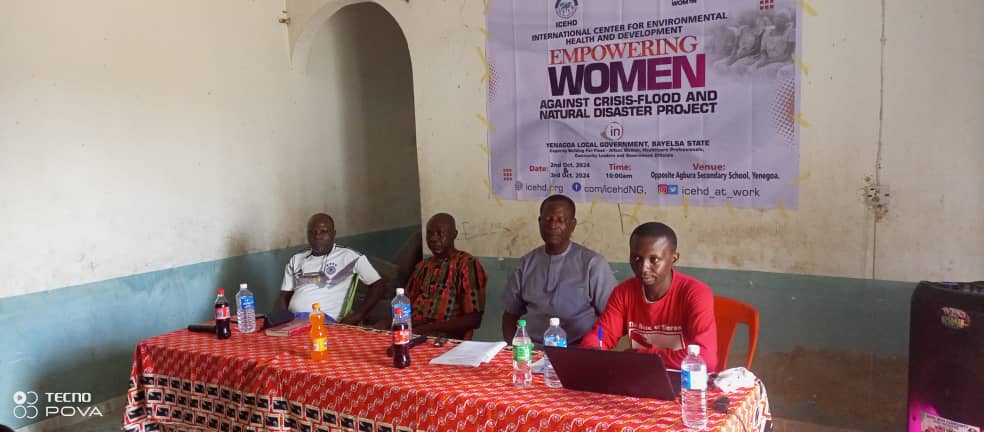
YENAGOA, BAYELSA STATE, NIGERIA — The International Centre for Environmental Health and Development (ICEHD) has strengthened the capacity of women and vulnerable community members in flood-affected communities in Bayelsa State through an integrated intervention focused on disaster preparedness, healthcare, livelihood recovery, climate adaptation and access to clean water.
Implemented in Azikoro, Agbura and Amassoma communities in Yenagoa Local Government Area, the Empowering Women Against Crisis – Flood and Natural Disaster Project reached 1,122 individuals through a series of community-based interventions designed to support recovery while improving preparedness for future climate-related emergencies.
The project responded to the disproportionate impact of flooding on women and girls, particularly women farmers whose livelihoods, household income and food security were severely affected by the destruction of farms and productive assets.
Supporting women to rebuild after flooding
As floodwaters disrupted agricultural activities and household livelihoods, ICEHD provided 37 women and families with agricultural and protective resources to support livelihood recovery.
The support included yam seedlings, cassava stems, plantain suckers, organic fertilisers, raincoats, rain boots and other farm resources.
Beyond replacing lost agricultural inputs, the intervention incorporated training on climate-smart agriculture, adaptation and mitigation, encouraging women farmers to consider farming practices and crops that are better suited to changing climatic conditions and flood-prone environments.
The approach reflects ICEHD's broader focus on helping women move from short-term recovery towards greater economic and climate resilience.
Strengthening emergency maternal health response
The flooding also exposed critical gaps in access to maternal healthcare, particularly when transportation routes became inaccessible.
Traditional Birth Attendants (TBAs), who often serve as important community-level healthcare providers, reported having to support pregnant women during emergency situations despite limited access to emergency maternal health resources and training.
In response, ICEHD organised emergency maternal health training involving 30 Traditional Birth Attendants, four medical practitioners and one Ministry of Health official.
The training focused on recognising the nine emergency signs in maternal care, appropriate first response and the importance of timely referral when complications occur.
The intervention highlighted the importance of ensuring that frontline community health providers have the knowledge and preparedness required to act before and during emergencies.
Medical outreach reaches 85 women
As part of the crisis response, ICEHD also provided free medical services to 85 women in affected communities.
The outreach included health consultations, malaria screening, maternal health support, blood pressure checks, eye tests, treatment for common health conditions and health education.
The programme also promoted hygiene and disease prevention in response to increased health risks associated with flooding and unsafe water.
Borehole improves access to clean water
Access to safe drinking water was another major concern identified during the intervention.
ICEHD supported the installation and commissioning of a borehole in Azikoro, improving access to clean water for approximately 1,000 community members.
The intervention is particularly significant for women and girls, who often bear substantial responsibility for collecting water and managing household needs.
By improving access to a safer water source, the project contributed to reducing reliance on potentially unsafe water sources and strengthening community-level protection against waterborne diseases.
However, the project also identified the need for additional water infrastructure, as one borehole cannot adequately meet the needs of the wider community.
Mental health included in crisis response
Recognising that the impact of disasters extends beyond physical and economic losses, ICEHD provided psychological support and counselling to 60 women, girls and community members affected by the crisis.
The support focused on helping participants manage stress, emotional distress and the psychological effects associated with loss, uncertainty and disruption caused by flooding.
Project monitoring reported a 50 percent reduction in reported stress and anxiety among participants who received the intervention.
85 community members trained in disaster preparedness
ICEHD also trained 85 community members in disaster preparedness, emergency response, climate adaptation and financial literacy.
The training was designed to strengthen participants' understanding of climate-related risks and equip them with practical knowledge to prepare for emergencies, protect household resources and make informed decisions during crises.
The intervention reinforced the importance of community-level preparedness, particularly in locations where flooding can quickly disrupt transportation, healthcare and livelihoods.
Flooding tests community response capacity
The implementation period also presented significant operational challenges.
Flooded roads affected transportation and made movement between communities difficult for staff, health workers, volunteers and participants. Some women also faced difficulties attending training consistently because of economic pressures and household responsibilities.
The availability of medical personnel was another challenge, with some professionals unable to participate because of competing emergencies and transportation difficulties.
The construction of the Azikoro borehole also presented technical and logistical challenges due to the nature of the land and the difficulty of identifying an appropriate location.
Rather than viewing these challenges solely as implementation constraints, ICEHD said they provided important lessons for strengthening future crisis-response planning.
Building a stronger model for future emergencies
The experience has strengthened ICEHD's focus on preparedness, prevention, resilience and women-led solutions.
Future priorities include expanding emergency maternal health training for TBAs, strengthening community health and emergency response capacity, supporting women farmers with climate-resilient agricultural knowledge and resources, advocating for additional water infrastructure and deepening partnerships with government institutions, health professionals, community leaders and development organisations.
The project also reinforced the importance of involving women and young people in disaster preparedness and recovery.
Women in the affected communities demonstrated that they are not only among those most affected by climate-related disasters but are also critical actors in community response and recovery.
A call for sustained investment
The Bayelsa intervention demonstrates the close relationship between climate change, women's economic empowerment, health, livelihoods and access to essential services.
For communities experiencing recurrent flooding, recovery cannot end when floodwaters recede.
Sustained investment is needed to help women rebuild livelihoods, strengthen emergency health systems, improve access to clean water and develop practical strategies for adapting to increasing climate risks.
ICEHD is therefore advocating for continued collaboration and investment in community-based solutions that place women at the centre of climate resilience and disaster preparedness.
The organisation believes that when women have access to the knowledge, resources, services and leadership opportunities they need, they can play a powerful role in strengthening the resilience of their families and communities.
The lesson from Bayelsa is clear: effective disaster response must not only help communities recover from the crisis they have experienced—it must also prepare them for the crisis that may come next.